


This is where many traders slip up.
They add pages and pages of rules and regulations.
“Do this, don’t do that. Take this trade, not that. Wait for this candle, not that.”
It’s a sea of trading rules you cannot possibly stick to!
And once you break a rule, it’s too easy to throw the whole trading plan out of the window.
We don’t want to do that…
You want a simple trading guide with a few clear rules that will help you:
 Not go outside of your trade risk levels Keep you focused on the trade setups that work Prevent you from sliding into destructive trading behaviours
“Setting clear trading objectives for yourself is crucial for maintaining discipline, focus, and consistency in your trading decisions.”
The plan is not there to remove all the intuition and discretion from your trading. As a discretionary trader, I always believe you need to nurture that trading intuition, not suppress it.
You want:
1) Risk rules,
2) Trading strategies
3) Goals.
Before setting these rules, evaluate your risk tolerance and risk appetite… think very carefully, “would I be comfortable losing this on a trade?” If the answer is no, decrease your risk limits.
That’s it.
Long-winded multi-page trading plans will never be adhered to. (you know ‘cos you’ve tried it right!)
A simple plan that stays on your screen next to your trading charts during the day will help you remember what’s important.

So, if we agree that long trading plans aren’t that useful. How do we add all the information we need into the plan?
By using what I call a modular approach.
What does that mean?
Well, it’s an approach that I found works for me over the years, so I’ll share it with you, and you can make your own decision 
Our trading plans should be simple and short, but at the same time, we need to understand the nuances of our setups, the rules, the screen shots. So how do we achieve both?
We create a simple trading plan, but then link to other more in-depth documents. Voila! One simple plan, supported by the longer stuff.
Let me explain…
Let’s say we want to use a specific trading strategy in our plan.
And let’s use the solid opening range breakout strategy as an example.
What we don’t want to do is fill the plan up with the rules, trade filters, trade triggers, example screenshots etc for that strategy. (We want to keep things short and simple, remember)
The trading plan needs to be simple, but we still want to go into depth and document the trading strategy in as much detail as possible.
Nuances like when to pull the trigger on a trade, targets, stop loss areas, add points, scaling rules, and sizing.
If we don’t want to clutter up the plan what do we do?
The answer here is to reference the trading strategies from within that plan. But have a separate trading strategy document that goes into more detail.
This modular approach allows us to add multiple strategies to the plan while keeping the master plan simple to read.
Make sense?! 
But wait, we need more in our plan….
Another example of a key component of your trading that needs to be in your plan might be a trading routine or trading checklist you want to run through at specific times.
Trading checklists are a great way to ensure you stick to a process you know gives you the highest chance of success.
Yet you don’t want to outline every checklist in your plan. This would clutter it up.
So just like we linked out to specific stategy documents before, we do the same here and reference any checklist document seperately…
Example trading checklists:
Before the trading day, I will run through a pre-market checklist At the end of the trading day, I will complete a session debrief (Check out my guide to journaling for day traders)
This is a good point to remind you that it’s crucial to start a trading journal to document your trades, emotions, and the rationale behind your decisions. This helps you track your performance and make informed adjustments to your trading strategies over time.
Trading Plan Pro is a decent trading journal to consider.
All very important, but again we don’t want this cluttering up the plan…
Remember, your trading plan should be treated as a living document that evolves with your experience and changing market conditions.

Remember, each of your trading strategies has more detail elsewhere, but they are referenced in your trading plan.
When developing your trading strategies, some traders like charts, some like backtests, others use a blend of both technical analysis and fundamental analysis to make a decision… up to you. (I go into depth on building your trading strategies here)
Price, charts and sometimes technical indicators can play a crucial role in guiding your trade entry and exit points, helping you determine when to open or close that trade…
It’s also important to set clear entry and exit points,…with those entry/exit signals based on specific, objective conditions. e.g., some traders like to use technical indicators or candlestick patterns.
Always do your own market analysis. Identify any market trends and observe price movements for yourself… your own work will help you spot potential decent trading opportunities.
Stop losses are key, of course, but also consider setting profit targets as part of your trading strategy to lock in gains and manage risk effectively.
Sometimes you’ll get a nice runner… sometimes you won’t. 
Here are some strategy examples you might include:
 To capture momentum moves outside of ranges
(This gives us clarity on the type of trader we are trying to be)
Identifying your trading style is crucial, as it should reflect your personality, resources, and preferences. Textbooks say trading styles include day trading, swing trading, position trading, and long-term investing. But active traders are looking for more nuance than that.
Do you focus on the Nasdaq opening drive? Trade Gold in the Asian session? Or Scalp Yen?
That’s the level of detail you need here…
Choose a trading style that suits your strengths, weaknesses, and available time. (This gives us clarity on the type of trader we are trying to be)
Before you start trading, decide how much trading capital or available capital you can afford to dedicate to trading. This is essential for responsible risk management and helps you determine how much capital to allocate per trade.
Your risk is clearly defined and broken down into trade, day and weekly risk.
For every single trade, calculate risk carefully and avoid being tempted to put too much capital into a single position. Use position sizing rules that factor in volatility and your total capital to determine how much to invest in each trade.
Set a maximum daily drawdown to limit how much can be lost in a day…. if this limit is reached, stop trading for the day to protect your trading capital. (I know it sounds boring, but this is where the hidden risk is in trading…)
eg:
Daily Risk = $500 Weekly Risk = $2,000 Trade Risk = $150
4 key trading rules we will stick to.
 Walk away after a loss of $500 Do not trade in the first 5 minutes No more than 3 losing trades in a row A max of 50% drawdown from days P&L high
Maintaining trading discipline is essential, especially when executing and exiting trades, to avoid impulsive decisions and stick to your plan.
And it’s even more important when it comes to your risk rules….
Also, remember to set clear exit point criteria for every trade. This helps manage risk and lock in profits without overthinking; (if you’re an automated trading guy, you can consider using automated exit points to remove emotional interference)
As you gain experience and as market conditions change, remember to adjust your trading rules to stay effective…
It might sound obvious but we need to define the market or markets we will focus on. (to stop us from getting shiny object syndrome!)
“Market selection is a crucial step… choose your market or markets based on your knowledge and comfort level with different asset classes, such as forex, stocks, or commodities. Assessing your familiarity with various asset classes helps determine which markets are most suitable for your trading plan and risk management approach.”
If you are trading forex, you might want to focus on major currency pairs like EURUSD, GBPUSD, and USDJPY. These pairs offer high liquidity, tight spreads, and significant trading volume.
 EURUSD
 GBPUSD
 USDJPY
Ok so…
1) We’ve chosen the strategies we’ll deploy
2) When the trade setups trigger.
This is where you list all the strategies you’ll deploy, with links out to deeper explanations and chart examples.
eg:
 Opening Range Breakout
 VWAP Magnet
 DAX 7 am Alarm Clock

These are checklists we want to ensure we complete at key times during the trading day.
Just like a pilot completes pre-flight and pre-landing checklists to ensure nothing goes wrong, as traders, we want to mirror that professionalism.
Structuring your trading activities with routines and checklists helps maintain consistency and discipline in your trading practices.
I believe that specialising in one particular market or one specific strategy is the fastest path to consistency.
As is documenting your trading journey by keeping a trading journal or trading diary.
This allows you to track all the metrics that matter: Wins, losses, emotions, and market conditions, which are essential for refining your trading strategies and checklists over time.
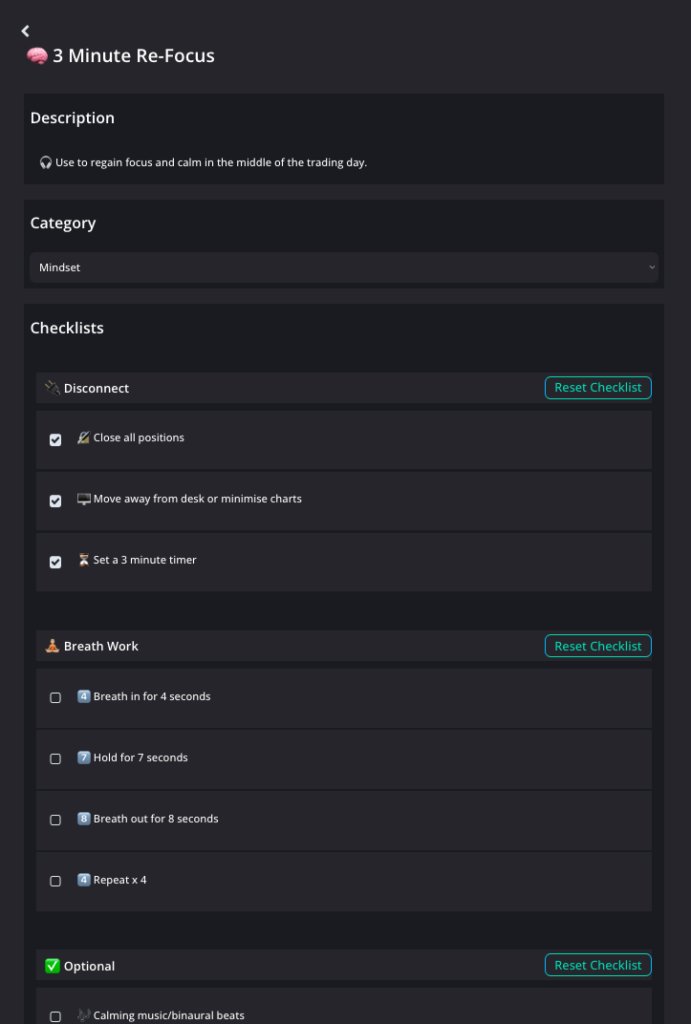
 3 Minute Re-Focus
 Prepare for the trading day
 Pre-Trade Checklist Trade Idea Generation
Finally, in this trading plan example, we have two key areas to focus on. Not 15, but 2!
TO STICK TO MY RISK RULES FOR TEN DAYS  TO FOCUS ON TAKING A+ TRADES ONLY
Less is more here. You just want to be doing ONE job during the trading session.


Pledge now to build a simple trading plan. 
Add all the key components of a trading plan and stick to it religiously for 10 days.
Just 10 days!
You can do that, right?
Then log the results. How did it go?
“Tracking your win rate and other trading performance metrics will help audit and improve your results.
Evaluating your trading performance by calculating total return, profit factor, and average win/loss can help you identify strengths and areas for improvement.” – Douglas Brown

